An Integrated Process for the Creative Production of New Information, Ideas, and Actions
A DBM® Art and Science Training
Created and Presented by John McWhirter, Creator of DBM®
Spanish translation by Tim Ingarfield
Overview
Practical thinking is one of our most important skills. Creative thinking has been the basis for all our major innovations. In this practical training participants will learn about the new modelling that has created major new models for understanding and producing creative thinking and learn how to apply them through understanding and practising the underlying processes and skills.
The most well-known thinking processes are Deduction and Induction. Often single examples of each are used to teach how they work. When we study how we actually think, when we are being creative, problem-solving, thinking through issues, there is seldom only one simple process of Deduction or Induction, there is usually a long sequence different thinking processes and contents, mulling over, cycling round things, in fact a complex “train of thought”. Understanding how these different process work and work together can greatly improve how effective we can be in our
thinking.
The famous American philosopher Peirce added a third type of thinking distinction, Abduction. He used many different names for abduction, which suggests that there are different types of abduction.
He rightfully claimed that only Abduction created something entirely new. Deduction identifies new specific content within what is already known and Induction extends the scope of what is already known to a more general or universal form.
His most famous example of abduction though is one that completes a triad of steps that fit with the original deductive syllogism. His example most often used it that of a bag of beans.
| Deduction | |
|---|---|
| Rule | All serious knife wounds result in bleeding. |
| Case | This was a serious knife wound |
| Therefore Result | There was bleeding. |
| Induction | |
| Case | This was a serious knife wound. |
| Result | There was bleeding. |
| Therefore Result | All serious knife wounds result in bleeding. |
| Abduction | |
| Result | There was bleeding. |
| Rule | All serious knife wounds result in bleeding. |
| Therefore Case | This was a serious knife wound. |
Deductions are logically self-contained, each step a more detailed content of the same previous content. Abductions and Inductions are not logically self-contained. To be sure that they are correct they need to be externally validated. While there are identifiable fallacy structures in Deduction there are none for Induction and Abduction. This is an indication that they do not work in the same way as Deduction.
It should be clear that the type of Abduction that Peirce included in the table above is not an example of what Peirce said was unique about Abduction, namely, creating something totally new. The following quote from Gregory Bateson, who used the distinction of abduction that Peirce had created, is revealing. In Mind and Nature, P 139, Gregory Bateson writes, “Let us do a little abduction, seeking other cases which will be analogous to play in the sense of belonging under the same rule.” Here Bateson uses the language of Peirce, “cases” and “rules” (his examples provide the “results”) in a way that is very different form the three step syllogistic form. His application of Abduction goes well beyond the traditional content area of logic.
Peirce called abduction by the following names referring to different examples of abduction: Abduction, Abductory induction, Retro-duction, Hypothesis, Guessing, Presumptive inferences, Originary Argument, and Speculative modelling. Clearly there are a number of different processes being described. There is a great potential benefit in identifying precisely what they are and how they work, and how they relate to each other.
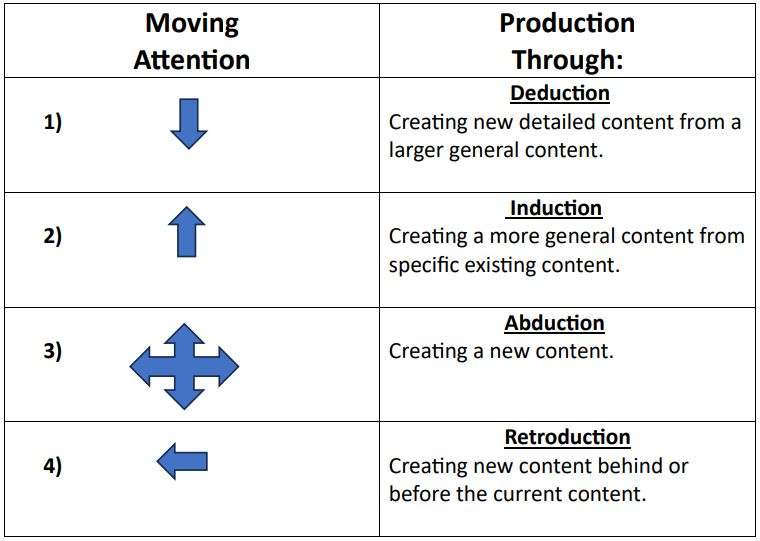
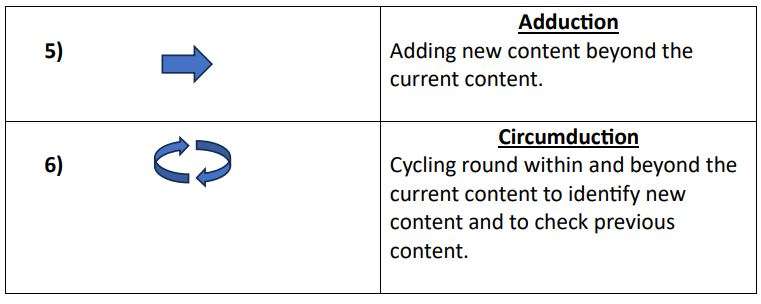
This is what John McWhirter has been studying for many years. He has modelled many different thinking processes and skills. His latest work will be included in this training, including an integration of the process of Deduction, Induction, Abduction, Retroduction, Adduction and Circumduction. For even greater precision and effectiveness John has developed the at the Fractal level.
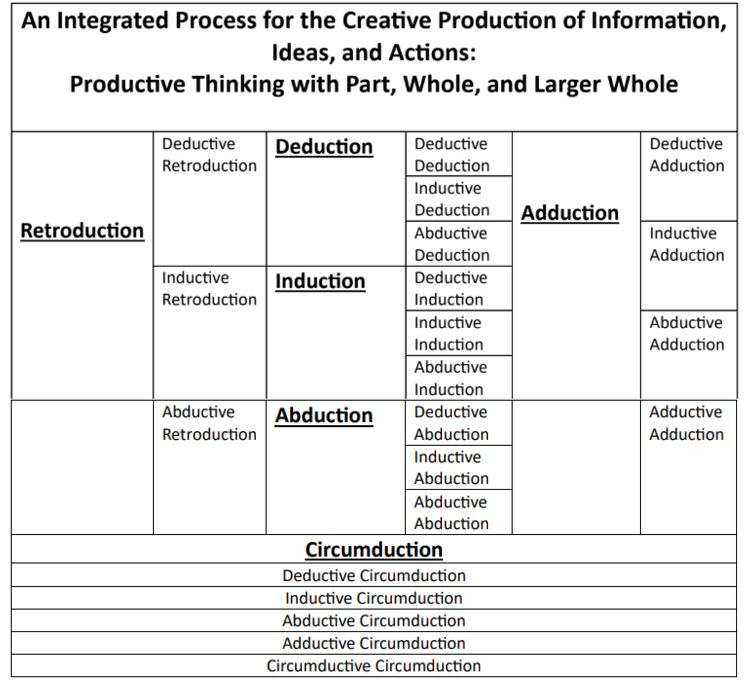
In the training John will also include other new developments include how all six thinking processes work together, how to manage our thinking and how to manipulate content to create new content.
Moving attention and Using Thinking Processes for Productive Thinking
How we use our attending, coordinated with manipulating specific contents enables us to create more effectively. Real world thinking is seldom a single deduction, induction, or any of the other processes. For effective problem solving, creativity, and innovation we often think in long sequences, so called “trains of thought”. Being able to identify what works and manage to perform what works more effectively means identifying and linking the different thinking processes and using the relevant effective ways of attending. This will be a central part of the training. After Identifying and Selecting a content within a part, whole, or larger whole: